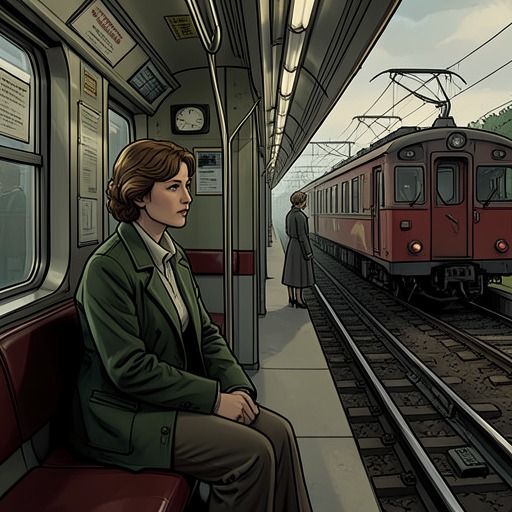
Megan Hipwell
The Girl on the TrainMegan Hipwell first appears to Rachel Watson as a figure glimpsed from a passing train and folded into an imagined domestic idyll. The story gradually replaces that projection with a woman shaped by bereavement, estrangement, and unresolved guilt. Her disappearance and death become central to the plot, but her own account also reveals a more private turning point: pregnant again, she decides to stop hiding and try to become the mother she could not be to Libby.
Identity and Background
Born Megan Mills in Rochester in 1983, she moved with her parents to King's Lynn when she was ten. A newspaper profile Rachel reads describes her as bright, sociable, artistic, and musical. Her brother Ben Mills was the person to whom she was especially close; he died in a motorcycle accident when Megan was fifteen. Three days after his funeral, she ran away from home. The account traces the ensuing rupture: she was arrested for theft and soliciting, and her relationship with her parents broke down. They died years later without reconciling with her.
At sixteen, Megan moved in with an older boyfriend near Holkham in north Norfolk. The newspaper account, attributed to a school friend, describes him as a musician involved with drugs, but Rachel notes that the report supplies no name and may not be reliable. That uncertainty matters: the reader first encounters Megan through fragments assembled by others, rather than through a settled, complete biography. By twenty-four she was living in London and working as a waitress. She met Scott Hipwell, an independent IT contractor friendly with the restaurant manager, and they married after an intense courtship: Megan was twenty-six, Scott thirty.
The Woman Seen from the Train
Before learning Megan’s identity, Rachel watches the house on Blenheim Road from her daily train journey and imagines its occupants as Jason and Jess. In Rachel’s fantasy, Jess is a beautiful, secure woman sharing an easy intimacy with Jason. The imagined couple stands in sharp contrast to Rachel’s own loneliness. This picture tells the reader as much about Rachel’s longing as it does about Megan: the woman at the window is first made into a reassuring image, not recognized as a person with an independent life.
The distinction becomes consequential when Rachel sees Megan on the lawn with someone other than Scott on the Friday before her disappearance. Rachel’s first account to Scott is hesitant, but the observation gives him a concrete reason to ask what she saw. Meanwhile, news coverage identifies Megan as a twenty-nine-year-old from 15 Blenheim Road who left home on Saturday evening, reportedly to visit a friend. She was wearing jeans and a red T-shirt, and her disappearance was described as out of character. When Rachel reads that Megan has not been seen for a week and that neither her phone nor bank cards have been used, she recognizes that the missing woman is not a mysterious figure placed in the background of her own story. Megan is real, and her absence has consequences beyond Rachel’s curiosity.
Motherhood, Loss, and a New Pregnancy
Megan’s history as a mother is marked by the death of her infant daughter, Libby. In her recollection, she describes waking in the bathroom with Libby in her arms, unable to make sense of what had happened. Mac came home, and Megan fled into the rain before he eventually brought her back. The next morning, she wrapped Libby in a sheet; Mac dug a grave near the disused railway line at the edge of the property, and they marked it with stones. They did not discuss the loss. Mac left that night and never returned. Megan’s account does not turn grief into a resolved past: the silence around Libby remains part of how she understands herself.
On Friday, 12 July 2013, Megan is pregnant again. At first she thinks she cannot bear the child, but thoughts of Libby change what she wants. After lying awake and considering the decision, she resolves to love and raise the baby and to do things differently. She connects that intention to her own history, remembering the identities she has passed through—from runaway and lover to someone who believes she has been a bad mother and wife. She is not certain she can remake herself as a good wife, but she wants to try to become a good mother. Her decision is also a commitment to tell the truth rather than keep hiding or running.
Megan tells Tom Watson that she is pregnant, while acknowledging that the child might be his or Scott’s. Tom’s eventual response is emotionally blank before he offers perfunctory congratulations. Later, he tells Rachel and Anna that Megan wanted the situation brought into the open and that she would accept his seeing the child if it was his. His account establishes why the pregnancy became the focus of their confrontation: Megan was asking for honesty and recognition, while Tom rejected responsibility.
Disappearance and Death
Megan disappears from her home on Saturday, 13 July 2013. On 1 August, a television report announces that a young woman’s body has been found submerged in floodwater in a field near Corly Wood, less than five miles from her home. The body has yet to be formally identified, but police believe it is Megan’s; the report says it appears to have been buried and uncovered by heavy rain. The discovery turns the search for a missing woman into an investigation of a death.
Tom later admits that he killed Megan during their confrontation. As he recounts it, she was insisting that the pregnancy and the possibility of his paternity be acknowledged, and threatening to tell Anna. He says he struck her and then killed her, before concealing her body in the woods. His confession supplies the truth that the earlier reports could not: Megan did not simply vanish, and her attempt to bring her pregnancy into the open ended in violence at Tom’s hands.
Narrative Role and Significance
Megan’s story is disclosed in fragments: a missing-person notice, a profile assembled from press accounts, Rachel’s observation from the train, and Megan’s own remembered voice. Each form corrects the one before it. Rachel’s imagined Jess is a projection; the newspaper version offers biographical facts but carries uncertainty; Megan’s recollections expose private grief and a deliberate resolve. The movement from being watched and described to speaking for herself shifts her from apparent mystery to a character with a history and a consequential choice.
Her pregnancy connects the loss of Libby to the life she hopes to make for her next child. The decision to tell the truth is therefore more than a disclosure to Tom: it is Megan’s attempt to break with secrecy and with the silence that followed Libby’s death. That effort does not secure the future she wants, but it clarifies what is at stake when Tom refuses to acknowledge the child. Megan’s final significance lies in the contrast between the idealized woman Rachel invents and the vulnerable, determined person whose life is cut short just as she begins to imagine doing things differently.